

From One Hypocrite to Another
The internet is anonymous. Christians aren't.


There’s a woman named Sharon McMahon who calls herself “America’s Government Teacher.” She’s a retired educator who uses plain language and wry humor to break down complex topics in government and politics through her social media and online newsletters.
I noticed a shift in her content around 2024. Her usual pronounced objectivity seemed to start to slide away… her posts became barbed, more opinionated, sometimes almost hostile.
And I realized this change seemed to start when this one thing began happening: Christians harassing her online.
She started posting Instagram slides not about what “gerrymandering” is, or why the filibuster is crucial to the Senate, but about how upset and angry she was at Christians online who had “scripture in [their] bio” but spewed hateful words to her in the comments of her posts.
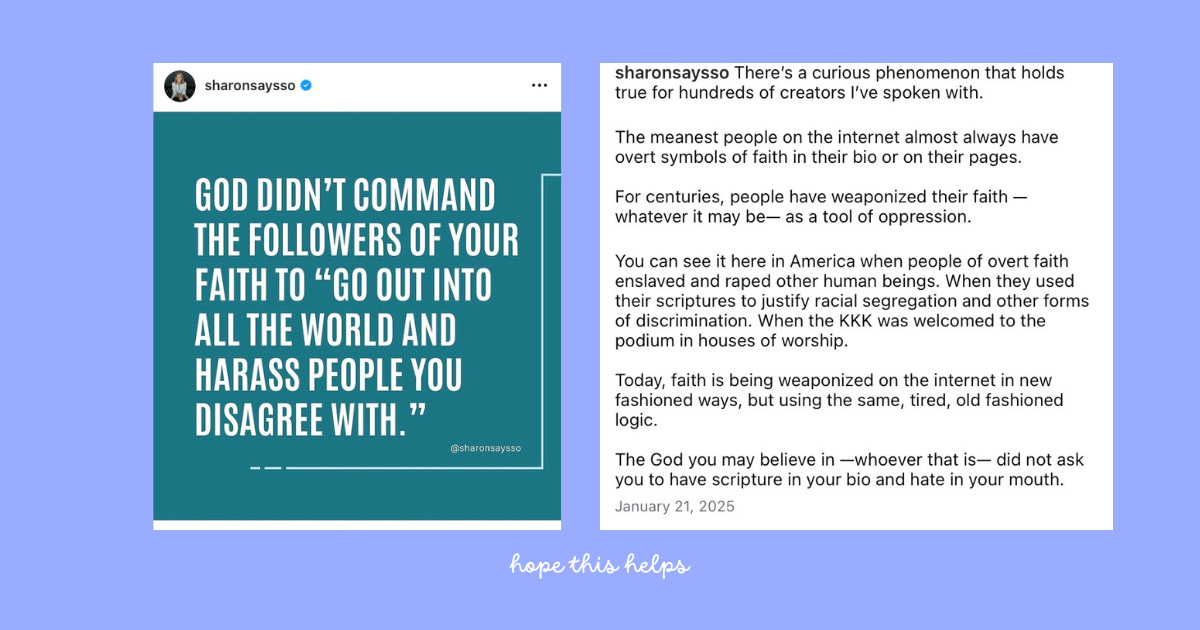
And you know what? She’s right to be frustrated.
How can you profess in your Instagram bio that you love Jesus, then tell a woman you wish she would die in a DM?
McMahon is the example at the top of my mind because it felt like I watched the harmful actions of Christians affect her in real time, but she’s far from the only victim of this behavior.
This is an open letter to my fellow Christians, and also an apology for anyone who doesn’t follow him but has encountered his believers in hurtful ways.
We need to get offline, touch grass, and acknowledge that we all, sometimes, can be hypocrites.
This is a little different from this Substack’s usual fare, so buckle up, buttercup.
Hope this helps!

For Christians:
Anger + Anonymity = Easy Hypocrisy
I believe one of the greatest hinderances to the movement of Jesus is hypocrisy.
Hypocrisy is nothing new, but the internet has made it particularly easy.
Jesus addresses hypocrisy in Luke 6:46:
“Why do you call me, ‘Lord, Lord,’ and do not do what I say?
It’s really hard to trust someone whose actions don’t align with their words.
The internet sells us the lie of anonymity. We don’t know these people we comment on, and they don’t know us. But while that person on social media who you desperately want to put in their place might not know you intimately, guess what? God does.
God made you. He can count every hair on your head and hear every thought inside it. There is no anonymity with Him.
Words you type on a phone keyboard are just as recorded in Heaven as the words you speak on the church steps.
“But I tell you that everyone will have to give account on the day of judgment for every empty word they have spoken.” Matthew 12:36
I’m just as guilty as anyone for choosing my own vindication in a situation over extending God’s mercy, so next time we machine-gun-text out a perfectly cutting response to someone, I hope this verse loops around in our minds before we hit “send.”
For Christians:
You Represent Jesus
How can anyone trust that God will love them if His followers don’t show love?
How can anyone trust that God will forgive them if His followers don’t forgive?
Have we forgotten this:
“Therefore we are ambassadors for Christ, as though God were making his appeal through us.” 2 Corinthians 5:20-21
The glow of your screen may feel like a mask hiding your true identity — but it’s actually exposing what’s in your heart and mind.
There are times when I have to defeat my own pride to display God’s humility.
I’m aware that sometimes I must reign in my own jealousy to showcase God’s celebration for others.
We’re not Jesus, so we’re not perfect. Being a Christian doesn’t mean that being like Christ comes naturally all the time. But that reality shouldn’t feel like a get-out-of-jail-free card to act with impunity, expecting God’s forgiveness to be whiteout to your sin’s sharpie’d scrawl.
That’s a great way to “show contempt for the riches of his kindness, forbearance and patience, not realizing that God's kindness is intended to lead you to repentance.” (Romans 2:4).
To follow Jesus is hard and imperfect and arduous because it’s work. The work of maturity, discipline, and constant attention. The work of repentance, forgiveness, patience, kindness, turning the other cheek.
“Whatever you do, work at it with all your heart, as working for the Lord…” Colossians 3:23
I’m not asserting that you must strive for God’s grace; we cannot earn that no matter what we do, which is why it’s freely given to us.
But being “transformed by the renewing of our mind” (Romans 12:2) is not a passive endeavor. You are not a bystander to God’s “good work” in you that He wants to see come to completion! (Philippians 1:6)
For Christians:
You Know When It’s Wrong
1 Corinthians 2:16 says that when we have the Spirit of God within us, “we have the mind of Christ.”
If you are reading your Bible, praying, and meditating on the word of God, you know — you know when what you’re typing is better left unsaid. You know when your gut reaction to tweet or post something will throw fuel on the fire of anger and discontentment, instead of working to bank it.
Growing in spiritual maturity means growing in your ability to gut-check.
And if you’re unsure? Phone a friend. Or clumsily Google for scripture’s point of view, a la: “Bible verse on should I forgive this person who hurt me” [Spoiler: scripture says yes, you should.]
Pausing for a “Should I send this?” litmus test has rarely hurt anyone.
For Christians:
If You See Something, Say Something
If I were to guess, almost all of the proud Christians who write hate-filled and cruel words on the internet go to church on Sunday morning. Their friends, their families, their pastors all see what they post.
I don’t think the percentage of Christians who do this is large, they’re just loud. In any given church, it’s likely there’s a couple people who everyone knows are just a little more willing to let their bitterness, resentment, and judgement flow freely. And to talk with them would be awkward, so no one does it.
Do it. I’m aware that’s simple to write, but agonizing to do. If it helps, think of this: how many people could be turned away from God if you say nothing?
My lack of self-awareness as a high school Christian was cringeworthy. I can think of many hurtful things I said to others during school hours before I’d go to lead worship in my church youth group at night. I proudly professed Jesus while being blind to my own misrepresentation of him. It would have done me a world of good had anyone had the courage to point me out to me.
It’s time to be accountable for what we say — and to have the guts to hold the other believers in our lives accountable for what they say. If they claim to represent Jesus, guess what? They represent you, too.
For Everyone Else:
An Apology
In the face of hurt, “sorry” often feels insufficient.
An apology cannot undo harm or rewind the past.
If my actions, or the actions of anyone who professes belief in Jesus, have ever turned you away from him instead of drawing you closer, I am sorry.
Our belief should hold us to a higher standard, but I can only hope that the humanity that causes Jesus to extend grace to me will inspire grace from you, as well.
Please know that for every believer you see who flagrantly acts in opposition to God’s purpose, there is another believer quietly working to represent Him honorably.
As easy as it is to find proof of Christians messing up or misrepresenting God, I hope it’s just as easy for you to find Christians spreading hope and goodness in the world.
I know many wonderful human beings who have followed Jesus and loved people well their entire lives. I’m doing my best to be one of them.
I hope you meet someone who loves you like Jesus loves you.
And if that experience makes you a little more open, a little more willing to give God a chance — I can promise you He will show you love, mercy, compassion, and forgiveness better than we ever could.
Sincerely,
Brooke
See you next time!
If this helped, let me know by leaving a comment or shooting me a DM!